누가 Cleopatra VII와 데이트 했나요?
그나이우스 폼페이우스 날짜가 Cleopatra VII 일 때 ?에서 ?. 까지
율리우스 카이사르 날짜가 Cleopatra VII 일 때 ?에서 ?. 까지 나이 차이는 30 년 6개월 10일 이었다.
Cleopatra VII

Cleopatra VII Thea Philopator (Koine Greek: Κλεοπάτρα Θεά Φιλοπάτωρ, lit. 'Cleopatra father-loving goddess'; 70/69 BC – 10 or 12 August 30 BC) was Queen of the Ptolemaic Kingdom of Egypt from 51 to 30 BC, and the last active Hellenistic pharaoh. A member of the Ptolemaic dynasty, she was a descendant of its founder Ptolemy I Soter, a Macedonian Greek general and companion of Alexander the Great. Her first language was Koine Greek, and she is the only Ptolemaic ruler known to have learned the Egyptian language, among several others. After her death, Egypt became a province of the Roman Empire, marking the end of the Hellenistic period in the Mediterranean, which had begun during the reign of Alexander (336–323 BC).
Born in Alexandria, Cleopatra was the daughter of Ptolemy XII Auletes, who named her his heir before his death in 51 BC. Cleopatra began her reign alongside her brother Ptolemy XIII, but falling-out between them led to a civil war. Roman statesman Pompey fled to Egypt after losing the 48 BC Battle of Pharsalus against his rival Julius Caesar, the Roman dictator, in Caesar's civil war. Pompey had been a political ally of Ptolemy XII, but Ptolemy XIII had him ambushed and killed before Caesar arrived and occupied Alexandria. Caesar then attempted to reconcile the rival Ptolemaic siblings, but Ptolemy XIII's forces besieged Cleopatra and Caesar at the palace. Shortly after the siege was lifted by reinforcements, Ptolemy XIII died in the Battle of the Nile. Caesar declared Cleopatra and her brother Ptolemy XIV joint rulers, and maintained a private affair with Cleopatra which produced a son, Caesarion. Cleopatra traveled to Rome as a client queen in 46 and 44 BC, where she stayed at Caesar's villa. After Caesar's assassination, followed shortly afterwards by the sudden death of Ptolemy XIV (possibly murdered on Cleopatra's order), she named Caesarion co-ruler as Ptolemy XV.
In the Liberators' civil war of 43–42 BC, Cleopatra sided with the Roman Second Triumvirate formed by Caesar's heir Octavian, Mark Antony, and Marcus Aemilius Lepidus. After their meeting at Tarsos in 41 BC, the queen had an affair with Antony which produced three children. Antony became increasingly reliant on Cleopatra for both funding and military aid during his invasions of the Parthian Empire and the Kingdom of Armenia. The Donations of Alexandria declared their children rulers over various territories under Antony's authority. Octavian portrayed this event as an act of treason, forced Antony's allies in the Roman Senate to flee Rome in 32 BC, and declared war on Cleopatra. After defeating Antony and Cleopatra's naval fleet at the 31 BC Battle of Actium, Octavian's forces invaded Egypt in 30 BC and defeated Antony, leading to Antony's suicide. After his death, Cleopatra reportedly killed herself, probably by poisoning, to avoid being publicly displayed by Octavian in Roman triumphal procession.
Cleopatra's legacy survives in ancient and modern works of art. Roman historiography and Latin poetry produced a generally critical view of the queen that pervaded later Medieval and Renaissance literature. In the visual arts, her ancient depictions include Roman busts, paintings, and sculptures, cameo carvings and glass, Ptolemaic and Roman coinage, and reliefs. In Renaissance and Baroque art, she was the subject of many works including operas, paintings, poetry, sculptures, and theatrical dramas. She has become a pop culture icon of Egyptomania since the Victorian era, and in modern times, Cleopatra has appeared in the applied and fine arts, burlesque satire, Hollywood films, and brand images for commercial products.
더 알아보기...그나이우스 폼페이우스
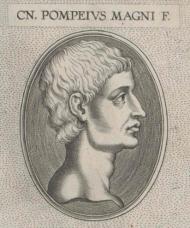
Cneo Pompeyo el Joven (75 a. C. - 45 a. C.), político y general romano de finales de la etapa republicana (siglo I a. C.).
더 알아보기...Cleopatra VII
율리우스 카이사르

Jules César (en latin : Caius Iulius Caesar à sa naissance, Imperator Iulius Caesar Divus après sa mort), aussi simplement appelé César, est un conquérant, homme d'État et écrivain romain, né le 12 ou le à Rome et mort le (aux ides de mars) dans la même ville.
Son parcours unique, au cœur du dernier siècle de la République romaine — bouleversée par les tensions sociales et les guerres civiles —, marque le monde romain. Ambitieux, il s'appuie sur le courant réformateur et démagogue (populares) pour favoriser son ascension politique. Stratège et tacticien, il repousse, à l'aide de ses armées, les frontières de la République romaine jusqu'au Rhin et à l'océan Atlantique en conquérant la Gaule, puis utilise ses légions pour s’emparer du pouvoir au cours de la guerre civile l’opposant à Pompée, son ancien allié, puis aux républicains.
Acclamé comme un imperator favorisé des dieux, seul maître à Rome après une suite de victoires foudroyantes sur ses adversaires, il entreprend de réformer l’État et satisfait les revendications de la mouvance des populares. Pour ce faire, il concentre progressivement de nombreux pouvoirs exceptionnels, adossés à une politique de culte de la personnalité inédite reposant sur ses ascendances divines et sa fortune personnelle.
Adoré du peuple, pour qui il fait montre de largesses frumentaires, économiques et foncières, il se fait nommer dictateur, d'abord pour dix ans avec des pouvoirs constitutionnels, puis à vie. Soupçonné de vouloir instaurer par ces mesures une nouvelle monarchie à Rome, il est assassiné peu après par une conspiration de sénateurs dirigée par Brutus et Cassius. Jules César est néanmoins divinisé.
Son héritage est rapidement l'objet d'une nouvelle guerre civile entre ses partisans et successeurs, Marc Antoine et son fils adoptif par testament, Octave. Triomphant de ses adversaires, Octave achève par sa victoire et par l'élimination des derniers républicains la réforme de la République romaine, qui laisse place au principat. Le nom César devient synonyme de pouvoir. Sa personnalité et son parcours sont l'objet de nombreux récits plus ou moins enjolivés dans les cultures du monde entier ; de même, sont désignées par le terme de « césarisme » les attitudes politiques visant à faire reposer un pouvoir personnel fort sur l'approbation populaire et sur le plébiscite.
더 알아보기...